

July 7th, 2026
8 min read
By
.png?width=1000&height=500&name=RideHome%20(1).png)
As a camp director for 33 years and a parent of two children, I know how important safety is when deciding on any activity, especially a summer camp, for your child. At Future Stars, we're honored that thousands of families have entrusted their children with us over our 40-year history.
In my experience, there are three distinct moments – during the ride home from camp, at the
dinner table, and at the end of the week – that give us as parents a chance to ask questions
about our children's safety at a summer program.
Why "How Was Camp?" Leaves Parents Guessing
Have you ever asked your child "How was camp?" only to get a one-word answer like "fine" or "good?" Or maybe you just get a shrug without even a word? Me too!
As a parent and camp director, here's what I've learned about going from one-word non-answers to real conversations.
"How was camp?”is actually a hard question to answer.
After a full day at camp (multiple activities, friendships forming and shifting, physical effort, emotional moments) children have processed an enormous amount of experiences, emotions, and information. An open-ended question like "how was camp?" asks them to sort through all of it at once. Most children, especially younger ones, find the task too large and default to the shortest answer that ends the conversation as quickly as possible.
Getting more specific can be really helpful.
A child who won't answer "how was camp?" will often answer "who did you sit next to at lunch today?" That question is small enough to hold, concrete enough to answer, and almost always goes somewhere.
The goal isn't to interrogate your child. It's to give them the right question for where they are at the moment.
The Three Moments That Work, and Why Each One Is Different
Not all conversation windows after camp give you the same information.
The Ride Home
The ride home catches children before they've had time to filter or reframe the day. Answers tend to be more immediate and less curated. This is the window for specific, concrete questions.
The Dinner Table
The dinner table gives the day more distance. Children have had time to settle, eat, and reconnect with family routine. This is when the social and relational picture becomes clearer, and when they're more likely to surface something that has been sitting with them.
The End-of-Week Check-In
The end-of-week check-in is the reflective window. Children can see patterns in a full week that they can't see mid-week. This is when you ask the broader questions.
The Ride Home: Questions That Get Real Answers
These questions work because they're specific enough to answer and open enough to go somewhere unexpected.
Pick one or a few. Don't put pressure on yourself (or your child) to cover all of these.
1. "Tell me one thing you did today that you'd never done before."
Camp is built around stretching children into new experiences. A child who can answer this was probably engaged. A child who consistently can't may be staying in familiar territory, and that's worth knowing as the summer goes on.
2. "Who did you sit next to at lunch?"
This is the lowest-pressure social question you can ask. The answer reveals friendship formation without putting any weight on it. If your child consistently eats alone or genuinely can't remember, that's a detail worth paying attention to.
3. "What was the hardest part of your day?"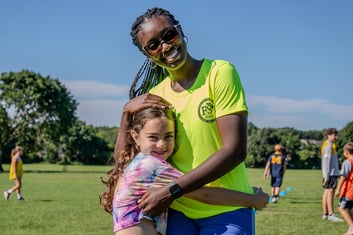
This question normalizes difficulty without framing camp as a problem. It signals to children that hard things are worth talking about. The answers are often small and manageable: a sport they struggled with, a moment that felt awkward. Occasionally they reveal something real.
4. "Did anything happen today that surprised you?"
Open enough to catch unexpected events without leading the child toward a specific concern. Children who are processing something unusual will sometimes surface it here when they wouldn't answer a more direct question.
5. "What does [counselor's name] do when kids have a hard time?"
This question tests whether your child notices and pays attention to how their adult supervisors handle difficulty. A child with a strong, trusting relationship to a counselor can usually answer this in specific terms. A child who doesn't know their counselor's name by the end of the first week may not have formed that connection yet.
Dinner Table: Questions That Reveal the Social and Safety Picture
These questions work best when the day has had a few hours to settle. Some children open up more at dinner than in the car; others need the change of environment.
1. "What did your counselor or coach do this week that you thought was fair? Anything that felt unfair?"
This is the most safety-relevant question on this list. A child who can describe a specific fair or unfair moment is paying attention to how adults treat them. Asking about both directions (fair and unfair) keeps the question from feeling like an accusation and leaves room for an honest answer.
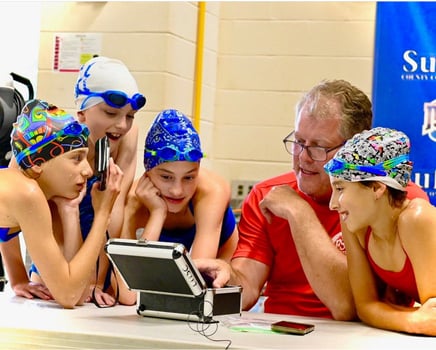 2. "Is there anyone at camp you've been trying to stay away from?"
This question surfaces peer dynamics and bullying without using the word "bullying." Children who are experiencing social difficulty often won't volunteer it, but many will answer when asked this directly.
3. "If something uncomfortable happened at camp, who would you tell?"
The answer reveals whether your child has a trusted adult at camp. That's one of the most important things a family can know. A child who says "I don't know" or "no one" deserves a conversation: talk about who at camp they could go to, and make sure they feel comfortable raising concerns with you at home.
4. "What's one thing you're looking forward to at camp this week, and one thing you're a little worried about?"
The balanced format matters here. Asking only about good things doesn't leave room for concerns. Asking only about worries can amplify anxiety. The pairing makes the question feel safer to answer honestly.
5. "What do the counselors do when kids argue or have a conflict?"
Children who feel safe at camp usually have a clear sense of how adults handle conflict. A child who can describe this specifically, even imperfectly, is paying attention to the camp's culture. A child who says adults aren't involved, or doesn't know, is giving you information worth following up on.
 End of Week: Questions for the Bigger View
End-of-week conversations work best when they're low-pressure: a quiet moment at home, not a debrief at the end of a long Friday.
1. "What was your favorite day this week, and what made it your favorite?"
Let them talk. The specific details they land on (a particular activity, a person, a moment) tell you what is actually mattering to them this summer.
2. "Is there anything that happened this week that felt wrong or made you uncomfortable?"
Ask this one plainly. Children need to hear the direct version of this question, not only the roundabout one. Asking it plainly also models that this is a normal question worth asking every week, not only when something seems off.
3. "What do you think your coach or counselor would say you're good at?"
A child who can't answer this may not have been noticed by their counselor yet. At a strong camp, children should feel recognized by the adults working with them.
4. "If you could change one thing about camp, what would it be?"
An open invitation for feedback with no pressure attached. Children often answer this more honestly than they'd answer "is there anything wrong?" because it frames the conversation around improvement rather than complaint.
Decoding the Answers: Green, Yellow, and Red Flags
The questions matter. Knowing how to read the answers matters just as much. Here is a working framework for what to listen for in the summer of 2026.
Green Flags: Signs the Camp Experience Is Going Well
- Your child names their counselors and coaches and can describe them specifically
- Your child recounts moments from the day with concrete detail: a particular play, a funny thing a friend said, a skill they worked on
- Your child is tired after camp, possibly grumpy, but their mood recovers once they're home and fed
- Your child can name an adult at camp they would go to if something felt wrong
- Your child brings up camp unprompted at home, replaying a game or talking about a friend
Yellow Flags: Worth Monitoring, Not Alarming
- "Fine" or "I don't know" answers that open up with follow-up questions (normal, especially in the first week of a session)
- Complaints about a specific activity the child doesn't enjoy (healthy differentiation, not a red flag)
- First-week adjustment behavior: some reluctance at drop-off, restlessness at home (common and usually short-lived)
Red Flags: Worth a Conversation with the Camp
- Flat, closed answers that persist across multiple days and don't open up with any follow-up
- Unable to name or describe their counselor after the first full week of a session
- New behavioral changes at home that persist across several days: disrupted sleep, changes in appetite, withdrawal from family, unusual irritability
- Physical reluctance before drop-off (stomachaches, dragging feet) that doesn't improve after the first week of a session
- Describes a moment involving an adult that made them feel unsafe, embarrassed, or singled out in a way that felt wrong
 When to Call the Camp and What to Say
If you notice a red flag, calling the camp is the right move. In my experience, the parents who wait, hoping the concern resolves on its own, often wish they had called sooner.
At Future Stars, when a parent calls, we welcome it and take the concern seriously. Safety is the first of our five core STARS values: Safety, Teamwork, Attitude, Responsibility, and Sportsmanship.
We'll typically connect you with the program director or the coach who spends the day with your child — someone who can speak to how your child is interacting, what they're working on, and how they're showing up at camp. That perspective, combined with what you know at home, gives us the clearest picture. If something feels off, trust that. We'd rather have a conversation that turns out to be nothing than miss something that matters.
What helps is coming to the conversation with specific observations rather than general worry. "My child hasn't been able to name their counselor after a full week, and they've been reluctant at drop-off three mornings in a row" gives the camp something to act on. "I'm just not sure what's wrong" is harder to work with, even though that feeling is absolutely worth trusting and raising.
As an American Camp Association (ACA) accredited summer camp, Future Stars meets rigorous standards for child well being. We value our partnership with families and want them to bring concerns forward quickly, not wait for scheduled check-ins.
This summer, my hope is that you're able to have deeper conversations with your child about their camp experience. The patterns you notice across a week (mood shifts, appetite changes, how your child talks about camp in the morning versus the evening) will give you the best insight. No one at camp can see those patterns the way you can, but we're here for you when you want to loop us in.
If you have questions or want to get in touch with our team, visit the Current Families menu of our site and select your location. You'll find resources, contact information, and everything you need to reach us directly.
 About the author
Jordan Snider has been part of the Future Stars family for over 30 years, bringing unparalleled expertise and passion to every aspect of the camp. A former camper himself, Jordan understands firsthand what makes a summer at Future Stars unforgettable. In his dual role as Director of Operations and Site Director for Purchase, he oversees all programs, ensuring every camper enjoys a safe, engaging, and enriching experience.
Jordan earned a BA in Psychology from Rollins College, where he was a member of the 1991 NCAA Division II National Championship tennis team and later served as team captain his senior year. The team consistently ranked in the Top 4 in the nation. He later earned an MBA from NYU’s Stern School of Business. Currently, he serves as Head Men’s Tennis Coach at Purchase College, leading the Panthers to multiple playoff appearances, earning Skyline Coach of the Year honors twice, and mentoring Skyline Rookies of the Year twice.
With nearly 20 years of experience teaching tennis to players of all ages and skill levels, he brings a proven passion for mentoring and developing young athletes. Beyond tennis, Jordan is deeply involved in youth sports. He is President of Briarcliff Youth Soccer Club and coaches youth soccer, basketball, and baseball. Jordan lives in Briarcliff with his wife Julie, whom he met at Future Stars. Now their children, Emily and Eli, join Jordan at camp each summer, soaking up all that the camp has to offer.
Since becoming Director of Future Stars in 1993, Jordan has grown the camp from just three programs serving a few hundred children to over 30 programs hosting thousands each summer. His leadership ensures every camper has the opportunity to learn, grow, and make lasting memories.
Future Stars Camps is an ACA-accredited day camp program with 11 locations across New York and Maine, offering more than 35 expert-led programs in sports, arts, academics, and STEAM for campers ages 2 to 18.
